



-
普通大蓟马(Megalurothrips usitatus)是热带和亚热带豆科植物上的植食性昆虫,主要分布于亚洲和大洋洲,近几年已传播至美洲多个国家[1−2]。在中国海南省,该虫是豇豆(Vigna unguiculata)害虫群落中的优势种,其发生与危害极大地阻碍了豇豆的丰产和增收[3−6]。普通大蓟马既可行两性生殖,也能进行产雄孤雌生殖(arrhenotoky),属于单倍-二倍体(haplodiploidy)生物[6],即雌虫为二倍体,由受精卵发育而成,未受精卵则发育成为单倍体雄虫。考虑到繁殖力和性比是影响蓟马种群数量增长的2个关键因子[7],探究普通大蓟马繁殖力和性比的调控机理十分必要。对此,多年的研究已取得了部分成果。普通大蓟马繁殖力的影响因子主要包括繁殖方式[8]、食物[5,8−10]、蓟马种间竞争[11]、温度[3]、氮肥施用水平[12]、杀虫剂[6]等。同种雌性成虫气味[13]、作物施氮水平[12]和紫外光[14]能改变普通大蓟马的子代性比,而寄主植物[8]、杀虫剂亚致死剂量[6],以及章鱼胺和酪胺[15]对该虫的性别分配没有干扰作用。
近些年来,植物挥发性有机化合物日益成为蓟马研究领域中的焦点[16−17],其中,水杨酸甲酯(Methyl salicylate,MeSA)在国内外备受关注。MeSA既是植食诱导的植物挥发物(Herbivory-induced plant volatiles,HIPVs),也属损伤诱导的挥发物(Damage-induced volatiles,DIVs)[18]。此外,MeSA还是一种空气传播的防御信号物质,能激活邻近植物的免疫响应[19−21]。迄今,有关MeSA与蓟马关系的研究侧重于以下2个方面:一是MeSA对蓟马的直接影响,主要涉及蓟马的趋性、取食和产卵行为[16,22−27],以及对蓟马的毒力[28];二是MeSA对蓟马的间接影响,涵盖寄主植物的诱导抗性[29−30]和对蓟马天敌的诱集能力[27,31−32]。研究人员曾检测发现,某些叶螨或害虫的取食与为害能刺激豇豆、大豆植株释放MeSA[33−34]。在虫害诱导释放的MeSA气味中,蓟马的繁殖和性别分配是否受到干扰呢?目前,国内外对此问题的探究尚属空白。本研究采用成虫熏蒸法,评价了不同浓度MeSA气味对普通大蓟马繁殖能力和性比的直接影响,所得结果对普通大蓟马绿色防控对策的研发具有指导意义。
-
在网室大棚内种植豇豆(品种:纯丰长豇豆Vigna unguiculata),按常规栽培技术与措施进行管理,选取健康、幼嫩的豆荚作为普通大蓟马的饲养材料。
-
在海南大学海甸校区植物保护教学实验基地(20°03′38″ N,110°19′46″ E),采集豇豆花朵内的普通大蓟马成虫,于室内用幼嫩的豇豆豆荚饲养,适时更换食物。饲养条件为(26±1)℃、相对湿度(60±5)%、光周期L(光照时间):D(黑暗时间)=14:10。当子代发育至2龄若虫时,用幼嫩豆荚在玻璃试管(12 mm×100 mm)中进行单头饲养。刚羽化的雌虫和雄虫配对饲养24 h后,挑选健康的、已交配的1日龄雌虫作为试虫。
-
Sigma公司出产的水杨酸甲酯(methyl salicylate,99%)和石蜡油。以石蜡油为溶剂[35],配制出不同浓度的MeSA溶液。
-
根据前期预备试验结果,参照Lu等[28]的报道,本试验设置4个处理:对照组(CK,不含MeSA)、
0.000 5 μL·L−1 MeSA、0.001 μL·L−1 MeSA和0.05 μL·L−1 MeSA处理。在离心管(5 mL)管壁侧面的中央开1个透气孔(10 mm×20 mm),并用孔径为42.86 μm的尼龙网封孔,防止试虫逃逸。每支离心管内放置1段幼嫩豇豆豆荚,接入1头已交配雌虫后,用棉花塞紧管口。然后将10支离心管放到特制的试管架上,再将试管架移到玻璃密封罐(2 L)中。取0.2 mL不同浓度MeSA溶液,添加到离心管(1.5 mL)内的滤纸条(5 mm×10 mm)上,用作MeSA气味源。利用真空泵与活性炭净化密封罐内的空气10 min后,放置MeSA气味源,然后立即封罐。4个处理的罐内MeSA气味浓度分别为0(不含MeSA)、0.000 5 、0.001和0.05 μL·L−1。每24 h更换离心管中的豆荚和气味源,直至亲代雌虫死亡。每处理测试30头亲代雌虫(即30次重复)。将更换出来的豆荚放置到新的玻璃试管(12 mm×100 mm)中,在无MeSA气味条件下继续饲养,直至子代成虫羽化。供试亲代雌虫及其子代的饲养条件均设定为(26±1)℃、相对湿度 60%±5%、光周期L:D=14h:10h。观察和记录亲代雌虫存活状况、子代成虫的性别和数量,计算子代性比(即雄性占成虫比例)和日性比。 -
利用WPS Office 2016进行数据整理和绘图分析;采用SPSS v26.0软件进行单因素方差分析(ANOVA)和Duncan多重比较法。子代性比需经反正弦转换后再进行统计分析[6,12,28]。
-
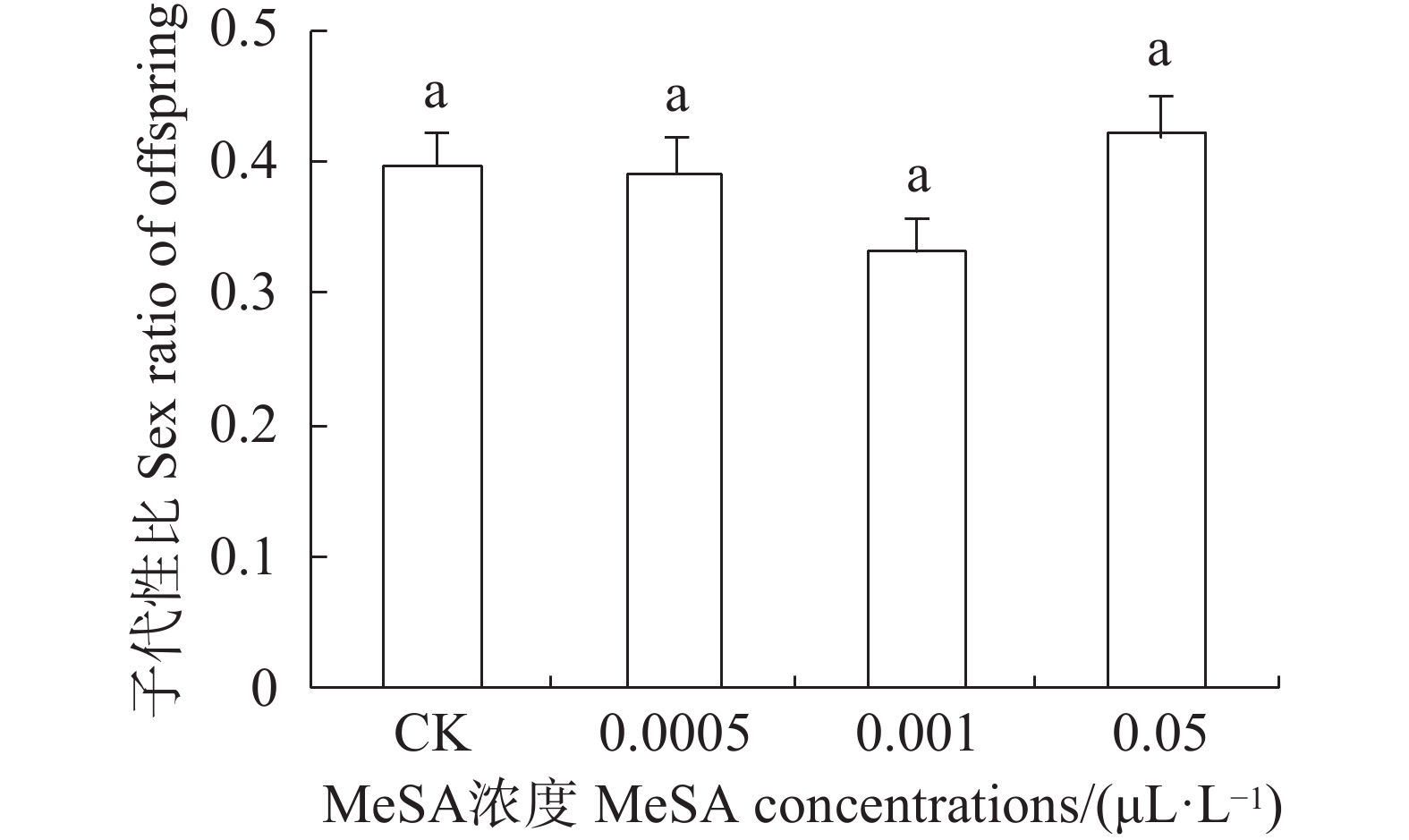
已交配普通大蓟马雌虫在不同浓度水杨酸甲酯(MeSA)气味胁迫下一生所产子代的性比见图1。对照组、
0.000 5 、0.001和0.05 μL·L–1 MeSA处理的雄性比分别为0.40、0.39、0.33和0.42,彼此之间无显著差异,表明0.000 5 ~0.05 μL·L–1 MeSA熏蒸处理普通大蓟马雌虫对其子代性别分配无明显影响。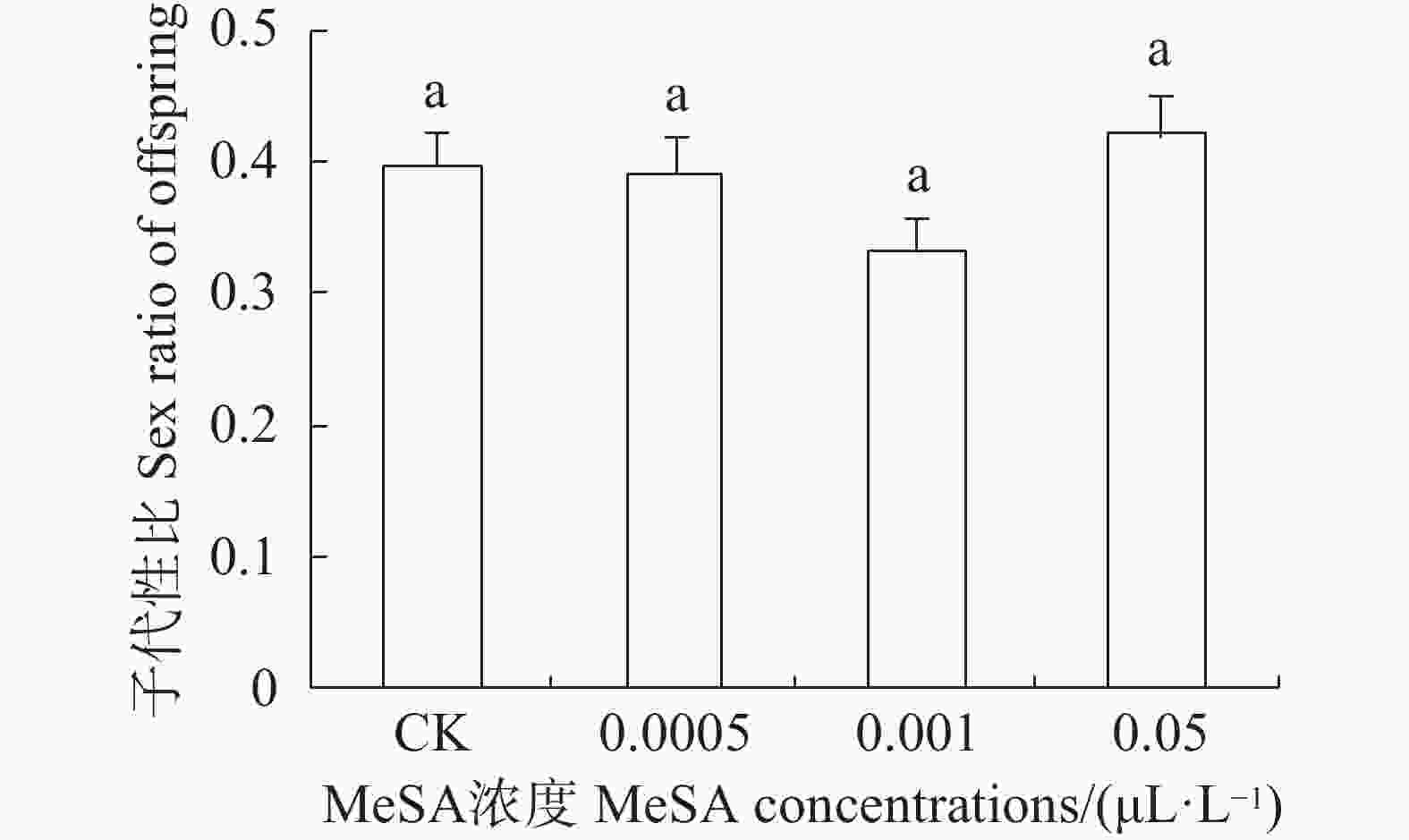
图 1 水杨酸甲酯气味胁迫下普通大蓟马所产子代性比
Figure 1. Offspring sex ratio in M. usitatus mated females exposed to MeSA odor
-
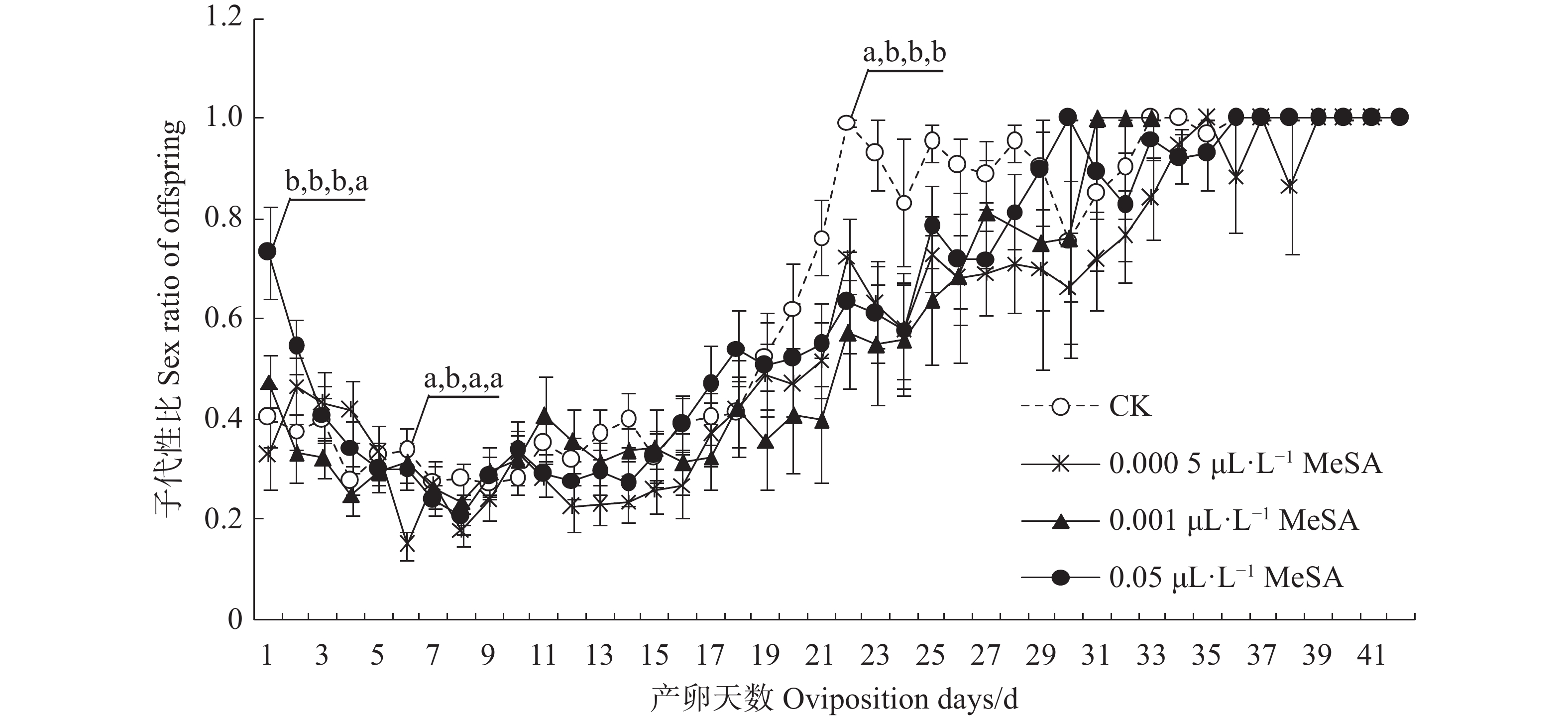
已交配普通大蓟马雌虫所产子代的日性比动态见图2。除了产卵第1天、第6天和第22天外,各处理的日性比之间差异不显著。0.05 μL·L–1 MeSA处理在产卵第1天的性比偏雄,高达0.73,显著大于其他处理(P<0.05)。在产卵第6天,
0.0005 μL·L–1 MeSA处理的性比最小,仅为0.15,与其他处理差异显著(P<0.05)。当成虫产卵周期进入第22天,对照组的性比增长至0.99,与另外3个处理之间的差异均达到了显著水平(P<0.05)。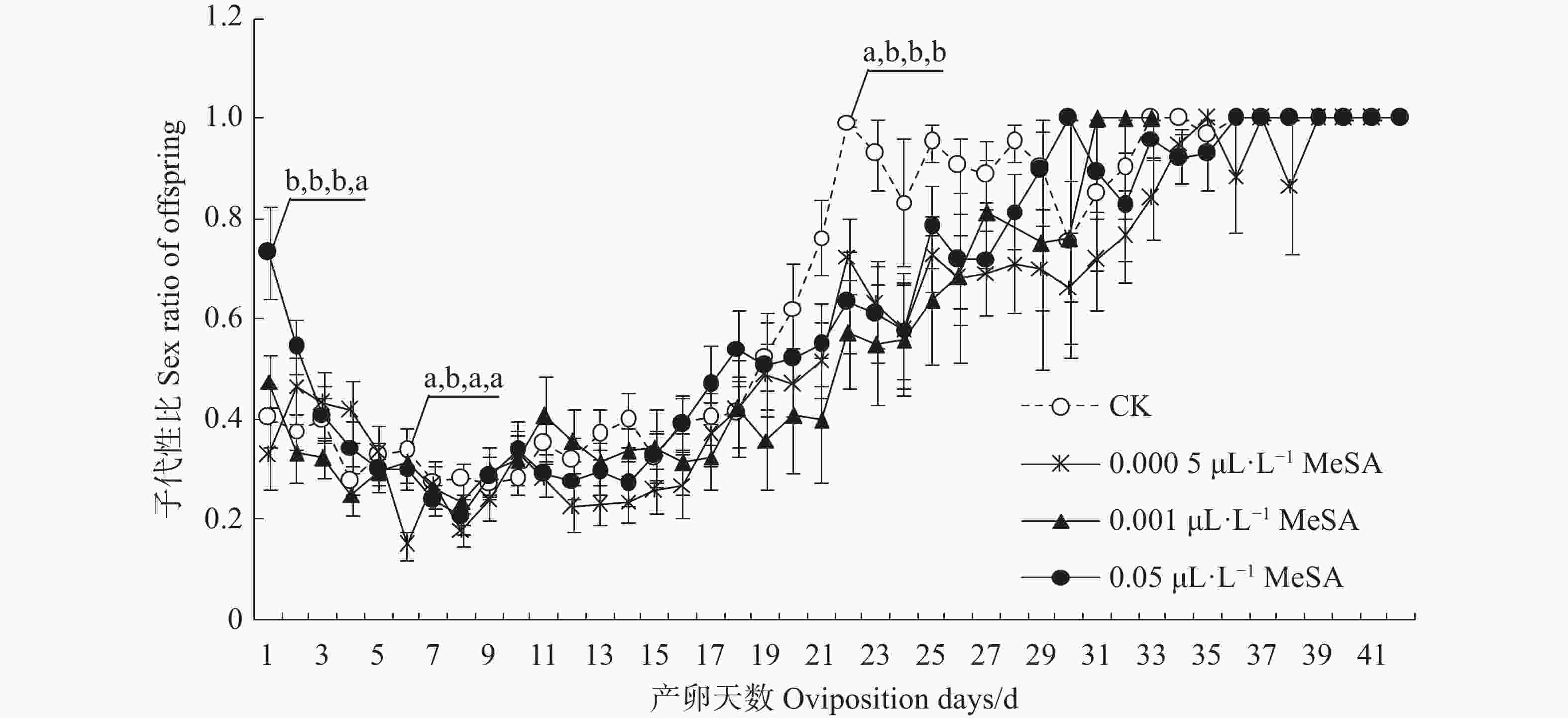
图 2 水杨酸甲酯气味胁迫下普通大蓟马子代性比日动态
Figure 2. Daily variation in sex ratio of offspring produced by M. usitatus mated females exposed to MeSA odor
对照组的日性比变化趋势与3个MeSA处理基本相似。在亲代雌虫产卵周期的前半期,各处理的日性比均偏雌,唯一例外的是0.05 μL·L–1 MeSA处理在产卵第1~2天的日性比为偏雄性比。随着产卵周期进入后半期,各处理的子代日性比逐渐增大,对照组、
0.0005 、0.001和0.05 μL·L–1 MeSA处理日性比大于0.5的出现时间分别为产卵第19天、第21天、第22天和第18 天。当对照组、0.000 5 、0.001和0.05 μL·L–1 MeSA处理亲代雌虫产卵周期分别进入产卵第33天、第35天、第31天和第30天后,所产子代几乎全为雄性(即性比等于1.0)。 -
暴露于不同浓度MeSA气味的普通大蓟马雌虫所产子代的成虫数量见表1。
表 1 水杨酸甲酯气味胁迫对普通大蓟马子代成虫数量的影响
Table 1. Effect of mated female’s exposure to MeSA odor on number of adult offspring of Megalurothrips usitatus
处理
Treatments子代成虫数量/(头·雌–1)
Number of adult offspring per female雄虫
Adult males雌虫
Adult females成虫
AdultsCK 100.73±11.47ab 136.03±5.80a 236.77±14.01a 0.0005
μL·L–1MeSA75.93±8.65bc 103.63±5.20b 179.57±10.43b 0.001
μL·L–1MeSA50.17±4.81c 102.30±7.88b 152.47±9.87b 0.05
μL·L–1MeSA111.80±14.89a 130.77±7.91a 242.57±17.47a 注:表中数值为平均数±标准误。同列数据后不同字母表示在P<0.05差异显著(Duncan多重比较法)。
Note: Values are means ± SE, and values with different letters within the same column are significantly different at the 0.05 level by Duncan’s multiple range test.子代雄虫数量:对照组、
0.000 5 、0.001和0.05 μL·L–1 MeSA处理的子代雄虫数量分别为100.73、75.93、50.17和111.80头·雌–1,其中,0.001 μL·L–1 MeSA处理与对照组和0.05 μL·L–1 MeSA处理之间的差异都达到了显著水平(P<0.05)。子代雌虫数量:
0.000 5 和0.001 μL·L–1 MeSA处理的子代雌虫数量较少,其值分别为103.63和102.30头·雌–1,显著小于对照(136.03头·雌–1)和0.05 μL·L–1 MeSA处理(130.77头·雌–1)(P<0.05)。子代成虫数量:子代成虫数量的情形与子代雌虫数量类似。
0.0005 和0.001 μL·L–1 MeSA处理的子代成虫数量之间差异不显著,介于152.47~179.57头·雌–1,与对照(236.77头·雌–1)和0.05 μL·L–1 MeSA 处理(242.57头·雌–1)的子代成虫数量均有显著差异(P<0.05),但0.05 μL·L–1 MeSA处理与对照的差异没有达到显著水平。由此可见,低浓度(
0.000 5 μL·L–1)和中浓度(0.001 μL·L–1)MeSA熏蒸处理已交配普通大蓟马雌虫,能减少其子代雌虫和成虫的数量,中浓度MeSA气味对子代雄虫数也有抑制作用;而高浓度(0.05 μL·L–1)MeSA气味对子代的雄虫数、雌虫数和成虫数都没有影响。 -
作为植物信号分子的水杨酸甲酯(MeSA)能影响某些昆虫的行为,在特定浓度范围内MeSA还对害虫具有熏杀活性[36]。MeSA通过与章鱼胺受体结合来杀死昆虫,被认为是章鱼胺受体拮抗剂[37]。Lu等[28]曾报道,MeSA可熏杀玉米黄呆蓟马(Anaphothrips obscurus)成虫和若虫,对成虫24 h的LC50为1.03 μL·L–1。本试验所施用的MeSA浓度(
0.0005 ~0.05 μL·L–1)远小于此值,应为亚致死剂量。采用
0.000 5 ~0.05 μL·L–1 MeSA熏蒸处理亲代雌虫对普通大蓟马子代性比没有显著影响。这与陈钰晴等[15]的实验结果是一致的,她们发现给普通大蓟马雌虫饲喂章鱼胺后,其雌性子代数和子代成虫数显著减少,但子代性比却没有显著变化。同样地,Zheng等[30]研究发现,MeSA(10 μmol·L–1)也没能改变西花蓟马子代性比的大小,但是,他们的MeSA施用方法有所不同。植株喷施MeSA后,再用叶盘法饲养西花蓟马雌虫,所得结果主要反映了MeSA诱导的植物抗性对西花蓟马子代性比的影响。本研究采用的是熏蒸法,所评价的是MeSA气味对普通大蓟马子代性比的直接影响。 -
用
0.0005 ~0.05 μL·L–1 MeSA熏蒸处理已交配普通大蓟马雌虫后,其日性比动态与对照基本相似。在产卵周期的前半期,子代日性比基本偏雌;随后,子代日性比逐渐增大;当产卵周期进入产卵第30~35天后,所产子代几乎全为雄性。这与其他蓟马的研究结果类似。据报道,西花蓟马[38]和美洲棘蓟马(Echinothrips americanus)[39]的子代性比也与亲代雌虫的年龄有关,在产卵期间的最后阶段所产子代的雄性比较高。很多寄生蜂也有类似的现象,子代雄性比随雌蜂年龄的增长而增加,其原因有多种,如精子逐渐消耗殆尽、精子的衰老、精子活力的下降、雌虫受精囊内精子释放能力的失控等[40−42]。 -
MeSA熏蒸处理已交配普通大蓟马雌虫对繁殖力的影响与MeSA气味浓度有着密切的关系。当MeSA气味浓度较低(
0.000 5 ~0.001 μL·L–1)时,普通大蓟马繁殖力下降,而高浓度MeSA(0.05 μL·L–1)气味展现出中性效果。通常,杀虫剂亚致死剂量对昆虫的影响呈现出双相剂量—效应(biphasic dose-response),即低剂量起刺激作用,而高剂量表现为抑制作用[43−44]。例如,LC10多杀菌素处理西花蓟马敏感品系雌虫能提高其繁殖力,LC25多杀菌素则导致繁殖力下降[45]。同样地,Morse和Zareh[46]发现,4种化学杀虫剂在较高浓度条件下能抑制柑橘蓟马(Scirtothrips citri)的繁殖,而低浓度对其繁殖力没有影响。但是,在本研究中,MeSA气味对普通大蓟马繁殖力展现出了不一样的剂量—效应关系。这种“低剂量抑制、高剂量无作用”的内在机理尚不明了,有待进一步探究。推测,这可能跟蓟马对MeSA气味的趋性有一定的关系。Chermenskaya等[22]曾利用嗅觉仪测定发现,低浓度MeSA气味对西花蓟马雌虫有明显的驱避作用,而高浓度MeSA对其趋向行为没有显著影响。因此,有必要在未来对普通大蓟马雌虫的趋化性与MeSA气味浓度的关系展开进一步研究。在蓟马IPM实践中,环境友好、绿色防控对策广受重视与期待[1,47]。有关挥发性化合物或植物精油对蓟马的影响已成为蓟马研究领域中的一个热点[17,48−50]。MeSA气味对普通大蓟马繁殖的低浓度抑制效应给我们的启示是:为了全面了解某种挥发物对蓟马的影响,不能忽视挥发物亚致死浓度所起的作用。的确,挥发物或植物精油对蓟马等害虫可展示出多重亚致死效应(驱避、拒食、阻止产卵等)[51−52]。因此,随着研究的深入,寻找到能使蓟马繁殖力大幅下降或性比高度偏雄的挥发物将会为蓟马的防控提供新的手段。
-
本研究利用成虫熏蒸法,评价了不同浓度水杨酸甲酯(MeSA)气味对已交配普通大蓟马繁殖能力和性别分配的直接影响。浓度为
0.000 5 ~0.05 μL·L–1的MeSA熏蒸处理亲代雌虫对该虫的性别分配没有干扰作用。3个MeSA气味处理的日性比动态与对照基本相似。低浓度气味(0.000 5 μL·L–1 MeSA)和中浓度气味(0.001 μL·L–1 MeSA)能显著降低其子代雌虫的数量,中浓度气味对子代雄虫的产生也展现出了显著的抑制作用。高浓度气味(0.05 μL·L–1 MeSA)则对上述繁殖参数均没有显著影响。此结论对进一步拓展MeSA在普通大蓟马IPM实践中的潜在价值具有指导意义。
已交配普通大蓟马的繁殖对水杨酸甲酯气味的响应
DOI: 10.15886/j.cnki.rdswxb.20250104
 CSTR: 32425.14.j.cnki.rdswxb.20250104
Reproductive response in mated females of Megalurothrips usitatus (Bagrall) (Thysanoptera: Thripidae) upon exposure to methyl salicylate odor
-
摘要: 普通大蓟马(Megalurothrips usitatus)是豆类作物上一种极难防治的害虫。为拓展水杨酸甲酯(methyl salicylate, MeSA)在该虫IPM实践中的潜在应用价值,本研究采用成虫熏蒸法,评价了MeSA气味浓度对已交配普通大蓟马繁殖和性比的影响。
0.000 5 、0.001和0.05 μL·L−1 MeSA处理的子代雄性比介于0.33~0.42,与对照无显著差异,其日性比动态也基本相似。0.000 5 和 0.001 μL·L–1 MeSA气味促使子代雌虫数显著减少至103头·雌−1左右,后者的子代雄虫数(50.17头·雌−1)也显著小于对照。本研究结果证实MeSA熏蒸处理已交配普通大蓟马雌虫对其子代性比没有干扰作用,但低浓度MeSA气味能降低其繁殖能力。低剂量MeSA抑繁效应可为该虫绿色防控新对策的研发提供依据。Abstract: Bean flower thrips, Megalurothrips usitatus (Bagnall) (Thysanoptera: Thripidae), is one of the economically important insect pests of leguminous crops and is very difficult to control. An attempt was made to determine whether reproduction and sex allocation in this thrips is affected by methyl salicylate (MeSA) odor for its potential application in IPM practice. One-day-old mated females were exposed to MeSA odor at concentrations of0.0005 , 0.001, and 0.05 μL·L–1, respectively, while unexposed females served as control. The sections of young cowpea pods were provided as food and egg-laying sites for the mated females, and replaced daily. Their offspring were reared without MeSA odor exposure until adult eclosion. The results showed that the sex ratio (proportion male) of the offspring for all the three MeSA treatments ranged from 0.33 to 0.42, which was not significantly different from that of the control. However, the number of adult female offspring decreased significantly down to approximately 103 per female upon exposure to0.0005 and 0.001 μL·L–1 MeSA. The latter treatment also caused a significant reduction in the number of adult male offspring with a value of 50.17 per female. In contrast, 0.05 μL·L–1 MeSA odor did not trigger any significant change in above reproductive parameters. These results confirm that MeSA odor exposure does not alter the offspring sex ratio of mated females of M. usitatus, but with a low-dose inhibitory effect on their offspring production, implying that low-dose MeSA may be used as an environmentally friendly tactic for control of the bean flower thrips.-
Key words:
- Megalurothrips usitatus /
- Vigna unguiculata /
- methyl salicylate /
- reproduction /
- sex ratio
-
图 2 水杨酸甲酯气味胁迫下普通大蓟马子代性比日动态
注:图中数据为平均值±标准误。同一天的数据标记上标有不同字母时,表示在P<0.05上差异显著(Duncan多重比较法)。
Fig. 2 Daily variation in sex ratio of offspring produced by M. usitatus mated females exposed to MeSA odor
Note: Values are means ± SE. Value markers with different letters on the same oviposition day indicates significant difference at 0.05 level by Duncan's multiple range test.
表 1 水杨酸甲酯气味胁迫对普通大蓟马子代成虫数量的影响
Table 1 Effect of mated female’s exposure to MeSA odor on number of adult offspring of Megalurothrips usitatus
处理
Treatments子代成虫数量/(头·雌–1)
Number of adult offspring per female雄虫
Adult males雌虫
Adult females成虫
AdultsCK 100.73±11.47ab 136.03±5.80a 236.77±14.01a 0.0005
μL·L–1MeSA75.93±8.65bc 103.63±5.20b 179.57±10.43b 0.001
μL·L–1MeSA50.17±4.81c 102.30±7.88b 152.47±9.87b 0.05
μL·L–1MeSA111.80±14.89a 130.77±7.91a 242.57±17.47a 注:表中数值为平均数±标准误。同列数据后不同字母表示在P<0.05差异显著(Duncan多重比较法)。
Note: Values are means ± SE, and values with different letters within the same column are significantly different at the 0.05 level by Duncan’s multiple range test. 下载: 导出CSV
-
[1] Tang L D, Guo L H, Wu J H, et al. Thrips in genus Megalurothrips (Thysanoptera: Thripidae): biodiversity, bioecology, and IPM [J]. Journal of Integrated Pest Management, 2023, 14(1): 8. https://doi.org/10.1093/jipm/pmad006 doi: 10.1093/jipm/pmad006 [2] Ivey C B, Hahn P G, Vallad G V, et al. Abundance of Megalurothrips usitatus (Bagnall) (Thysanoptera: Thripidae) and other thrips in commercial snap bean fields in the Homestead Agricultural Area (HAA)[J]. Florida Entomologist, 2025, 108(1): 20240075. https://doi.org/10.1515/flaent-2024-0075 doi: 10.1515/flaent-2024-0075 [3] 邱海燕, 刘奎, 李鹏, 等. 豆大蓟马的生物学特性研究[J]. 热带作物学报, 2014, 35(12): 2437−2441. https://doi.org/10.3969/j.issn.1000-2561.2014.12.021 doi: 10.3969/j.issn.1000-2561.2014.12.021 [4] 谭珂, 李曼娟, 陈鑫, 等. 普通大蓟马产卵选择性初探[J]. 热带作物学报, 2015, 36(3): 587−590. https://doi.org/10.3969/j.issn.1000-2561.2015.03.024 doi: 10.3969/j.issn.1000-2561.2015.03.024 [5] 谭珂, 陈鑫, 李曼娟, 等. 普通大蓟马在3种豆类作物上的实验种群生命表研究[J]. 热带作物学报, 2015, 36(5): 956−960. https://doi.org/10.3969/j.issn.1000-2561.2015.05.021 doi: 10.3969/j.issn.1000-2561.2015.05.021 [6] 罗亚丽, 施丹, 乔雪莹, 等. 杀虫剂亚致死浓度对普通大蓟马繁殖的影响[J]. 应用昆虫学报, 2020, 57(2): 427−433. https://doi.org/10.7679/j.issn.2095-1353.2020.048 doi: 10.7679/j.issn.2095-1353.2020.048 [7] Wang K, Shipp J L. Simulation model for population dynamics of Frankliniella occidentalis (Thysanoptera: Thripidae) on greenhouse cucumber [J]. Environmental Entomology, 2001, 30(6): 1073−1081. https://doi.org/10.1603/0046-225X-30.6.1073 doi: 10.1603/0046-225X-30.6.1073 [8] Tang L D, Yan K L, Fu B L, et al. The life table parameters of Megalurothrips usitatus (Thysanoptera: Thripidae) on four leguminous crops[J]. Florida Entomologist, 2015, 98(2): 620−625. https://doi.org/10.1653/024.098.0235 doi: 10.1653/024.098.0235 [9] Wang H T, Huang L F, Zheng X L, et al. An age-stage, two-sex life table for Megalurothrips usitatus feeding on eight different crop plants [J]. Agronomy, 2024, 14(10): 2283. https://doi.org/10.3390/agronomy14102283 doi: 10.3390/agronomy14102283 [10] Li T T, Liu Y, Liang X, et al. Potential influence of supplemental nutrients intake by adults on the development, fecundity, and population growth of Megalurothrips usitatus (Thysanoptera: Thripidae) offspring[J]. Journal of Economic Entomology, 2025, 118(2): 646−654. https://doi.org/10.1093/jee/toaf016 doi: 10.1093/jee/toaf016 [11] 禹云超, 郅军锐, 黄万庆, 等. 西花蓟马与豆大蓟马成虫数量和性别对彼此产卵量的影响[J]. 植物保护学报, 2020, 47(3): 508−516. https://doi.org/10.13802/j.cnki.zwbhxb.2020.2019152 doi: 10.13802/j.cnki.zwbhxb.2020.2019152 [12] 张仲, 邹游兴, 但建国. 施氮水平对普通大蓟马繁殖及子代性比的影响[J]. 热带生物学报, 2024, 15(1): 79−84. https://doi.org/10.15886/j.cnki.rdswxb.20230061 doi: 10.15886/j.cnki.rdswxb.20230061 [13] 杨鹤鸣, 叶子龙, 黄慧秀, 等. 普通大蓟马子代性比对同种成虫气味的响应[J]. 热带生物学报, 2022, 13(6): 628−633. https://doi.org/10.15886/j.cnki.rdswxb.2022.06.013 doi: 10.15886/j.cnki.rdswxb.2022.06.013 [14] Jin H F, Wang C Z, Jiang W, et al. Effect of ultraviolet on the environmental adaptability of Megalurothrips usitatus (Thysanoptera: Thripidae)[J]. Archives of Insect Biochemistry and Physiology, 2024, 116(4): e22141. https://doi.org/10.1002/arch.22141 doi: 10.1002/arch.22141 [15] 陈钰晴, 任英凯, 叶子龙, 等. 章鱼胺和酪胺及其受体拮抗剂对普通大蓟马子代性比的影响[J]. 应用昆虫学报, 2023, 60(5): 1519−1525. https://doi.org/10.7679/j.issn.2095-1353.2023.145 doi: 10.7679/j.issn.2095-1353.2023.145 [16] Kirk W D J, De kogel W J, Koschier E H, et al. Semiochemicals for thrips and their use in pest management [J]. Annual Review of Entomology, 2021, 66: 101−119. https://doi.org/10.1146/annurev-ento-022020-081531 doi: 10.1146/annurev-ento-022020-081531 [17] Cubillos-quijano L G, Díaz M, Coy-barrera E, et al. Untargeted volatile profiling identifies key compounds driving the attraction of western flower thrips to Alstroemeria cultivars[J]. Insects, 2025, 16(2): 216. https://doi.org/10.3390/insects16020216 doi: 10.3390/insects16020216 [18] Meents A K, Mithöfer A. Plant–plant communication: is there a role for volatile damage-associated molecular patterns?[J]. Frontiers in Plant Science, 2020, 11: 583275. https://doi.org/10.3389/fpls.2020.583275 doi: 10.3389/fpls.2020.583275 [19] Gondor O K, Pál M, Janda T, et al. The role of methyl salicylate in plant growth under stress conditions [J]. Journal of Plant Physiology, 2022, 277: 153809. https://doi.org/10.1016/j.jplph.2022.153809 doi: 10.1016/j.jplph.2022.153809 [20] Gong Q, Wang Y J, He L F, et al. Molecular basis of methyl-salicylate-mediated plant airborne defence [J]. Nature, 2023, 622(7981): 139−148. https://doi.org/10.1038/s41586-023-06533-3 doi: 10.1038/s41586-023-06533-3 [21] Bergman M E, Huang X Q, Baudino S, et al. Plant volatile organic compounds: Emission and perception in a changing world[J]. Current Opinion in Plant Biology, 2025, 85: 102706. https://doi.org/10.1016/j.pbi.2025.102706 doi: 10.1016/j.pbi.2025.102706 [22] Chermenskaya T D, Burov V N, Maniar S P, et al. Behavioural responses of western flower thrips, Frankliniella occidentalis (Pergande): to volatiles from three aromatic plants[J]. International Journal of Tropical Insect Science, 2001, 21(1): 67−72. https://doi.org/10.1017/S1742758400020063 doi: 10.1017/S1742758400020063 [23] Koschier E H, Hoffmann D, Riefler J. Influence of salicylaldehyde and methyl salicylate on post-landing behaviour of Frankliniella occidentalis Pergande [J]. Journal of Applied Entomology, 2007, 131(5): 362−367. https://doi.org/10.1111/j.1439-0418.2007.01191.x doi: 10.1111/j.1439-0418.2007.01191.x [24] Allsopp E, Prinsloo G J, Smart L E, et al. Methyl salicylate, thymol and carvacrol as oviposition deterrents for Frankliniella occidentalis (Pergande) on plum blossoms [J]. Arthropod-Plant Interactions, 2014, 8(5): 421−427. https://doi.org/10.1007/s11829-014-9323-2 doi: 10.1007/s11829-014-9323-2 [25] 李彩虹, 张涛, 陆宴辉. 烟蓟马成虫对不同植物挥发物的行为选择[J]. 应用昆虫学报, 2022, 59(1): 40−49. https://doi.org/10.7679/j.issn.2095-1353.2022.004 doi: 10.7679/j.issn.2095-1353.2022.004 [26] 金奕轩, 黄欣怡, 李思涵, 等. 西花蓟马对12种植物挥发物的选择行为[J]. 植物保护学报, 2023, 50(3): 676−683. https://doi.org/10.13802/j.cnki.zwbhxb.2023.2022071 doi: 10.13802/j.cnki.zwbhxb.2023.2022071 [27] Abana U C, Amarasekare K G. Efficacy of herbivore-induced plant volatile methyl salicylate in evaluating the seasonal abundance of herbivorous thrips (Thysanoptera: Thripidae) in sweet pepper [J]. Insects, 2024, 15(3): 156. https://doi.org/10.3390/insects15030156 doi: 10.3390/insects15030156 [28] Lu X P, Liu J H, Weng H, et al. Efficacy of binary combinations between methyl salicylate and carvacrol against thrips Anaphothrips obscurus: laboratory and field trials[J]. Pest Management Science, 2020, 76(2): 589−596. https://doi.org/10.1002/ps.5551 doi: 10.1002/ps.5551 [29] 牟峰, 郅军锐, 从春蕾, 等. 外源茉莉酸和水杨酸甲酯对西花蓟马生长发育和种群动态的影响[J]. 植物保护, 2014, 40(6): 70−74. https://doi.org/10.3969/j.issn.0529-1542.2014.06.013 doi: 10.3969/j.issn.0529-1542.2014.06.013 [30] Zheng X, Chen Y, Zhao L H, et al. Tripartite interactions between jasmonic/salicylic acid pathways, western flower thrips, and thrips-transmitted tomato zonate spot virus infection in Capsicuum annuum[J]. Arthropod-Plant Interactions, 2019, 13(2): 289−297. https://doi.org/10.1007/s11829-019-09683-2 doi: 10.1007/s11829-019-09683-2 [31] Lee J C. Effect of methyl salicylate-based lures on beneficial and pest arthropods in strawberry[J]. Environmental Entomology, 2010, 39(2): 653−660. https://doi.org/10.1603/EN09279 doi: 10.1603/EN09279 [32] Salamanca J, Souza B, Kyryczenko-roth V, et al. Methyl salicylate increases attraction and function of beneficial arthropods in cranberries[J]. Insects, 2019, 10(12): 423. https://doi.org/10.3390/insects10120423 doi: 10.3390/insects10120423 [33] Van den boom C E M, Van beek T A, Posthumus M A, et al. Qualitative and quantitative variation among volatile profiles induced by Tetranychus urticae feeding on plants from various families[J]. Journal of Chemical Ecology, 2004, 30(1): 69−89. https://doi.org/10.1023/B:JOEC.0000013183.72915.99 doi: 10.1023/B:JOEC.0000013183.72915.99 [34] Qualley A V, Dudareva N. Aromatic volatiles and their involvement in plant defense[M]//SCHALLER A. Induced plant resistance to herbivory. Dordrecht: Springer, 2008: 409-432. doi: 10.1007/978-1-4020-8182-8_20 [35] Yang L L, Wang B, Shen J, et al. Comparative morphology and plant volatile responses of antennal sensilla in Cinara cedri (Hemiptera: Lachninae): Eriosoma lanigerum (Hemiptera: Eriosomatinae): and Therioaphis trifolii (Hemiptera: Calaphidinae)[J]. Frontiers in Cellular Neuroscience, 2023, 17: 1162349. https://doi.org/10.3389/fncel.2023.1162349 doi: 10.3389/fncel.2023.1162349 [36] Guarino S, Arif M A, Cerasa G, et al. Methyl salicylate as a dose-dependent fumigant against common stored product pests: a comparative laboratory study[J]. Journal of Stored Products Research, 2025, 114: 102716. https://doi.org/10.1016/j.jspr.2025.102716 doi: 10.1016/j.jspr.2025.102716 [37] Enan E. Insecticidal activity of essential oils: octopaminergic sites of action[J]. Comparative Biochemistry and Physiology Part C: Toxicology & Pharmacology, 2001, 130(3): 325-337. doi: 10.1016/S1532-0456(01)00255-1 [38] Higgins C J, Myers J H. Sex ratio patterns and population dynamics of western flower thrips(Thysanoptera: Thripidae)[J]. Environmental Entomology, 1992, 21(2): 322−330. https://doi.org/10.1093/ee/21.2.322 doi: 10.1093/ee/21.2.322 [39] Li X W, Jiang H X, Zhang X C, et al. Post-mating interactions and their effects on fitness of female and male Echinothrips americanus (Thysanoptera: Thripidae): a new insect pest in China[J]. PLoS One, 2014, 9(1): e87725. https://doi.org/10.1371/journal.pone.0087725 doi: 10.1371/journal.pone.0087725 [40] King B H. Offspring sex ratios in parasitoid wasps[J]. The Quarterly Review of Biology, 1987, 62(4): 367−396. https://doi.org/10.1086/415618 doi: 10.1086/415618 [41] Chevrier C, Bressac C. Sperm storage and use after multiple mating in Dinarmus basalis (Hymenoptera: Pteromalidae)[J]. Journal of Insect Behavior, 2002, 15(3): 385−398. https://doi.org/10.1023/A:1016269210140 doi: 10.1023/A:1016269210140 [42] Liu P C, Wei H X, Cao D D, et al. Relationships amongst sex ratio of progeny in Anastatus disparis (Hymenoptera: Eupelmidae): sperm depletion and decreased fecundity[J]. Applied Entomology and Zoology, 2020, 55(1): 25−30. https://doi.org/10.1007/s13355-019-00648-8 doi: 10.1007/s13355-019-00648-8 [43] Cutler G C. Insects, insecticides and hormesis: evidence and considerations for study[J]. Dose-response, 2012, 11(2): 154−177. https://doi.org/10.2203/dose-response.12-008.Cutler doi: 10.2203/dose-response.12-008.Cutler [44] Cutler G C, Guedes R N C. Occurrence and significance of insecticide-induced hormesis in insects[M]//Duke S O, Kudsk P, Solomon K. Effects on the environment and target and non-target organisms. Washington: American Chemical Society, 2017: 101-119. https://doi.org/10.1021/bk-2017-1249.ch008 [45] Gong Y H, Xu B Y, Zhang Y J, et al. Demonstration of an adaptive response to preconditioning Frankliniella occidentalis (Pergande) to sublethal doses of spinosad: a hormetic-dose response[J]. Ecotoxicology, 2015, 24(5): 1141−1151. https://doi.org/10.1007/s10646-015-1461-5 doi: 10.1007/s10646-015-1461-5 [46] Morse J G, Zareh N. Pesticide-induced hormoligosis of citrus thrips (Thysanoptera: Thripidae) fecundity[J]. Journal of Economic Entomology, 1991, 84(4): 1169−1174. https://doi.org/10.1093/jee/84.4.1169 doi: 10.1093/jee/84.4.1169 [47] Mouden S, Sarmiento K F, Klinkhamer P G, et al. Integrated pest management in western flower thrips: Past, present and future[J]. Pest Management Science, 2017, 73(5): 813−822. https://doi.org/10.1002/ps.4531 doi: 10.1002/ps.4531 [48] Koschier E H. Essential oil compounds for thrips control–a review[J]. Natural Product Communications, 2008, 3(7): 1171−1182. https://doi.org/10.1177/1934578X0800300726 doi: 10.1177/1934578X0800300726 [49] Durr T D, Stratton C A, Dosoky N S, et al. Shared phytochemicals predict efficacy of essential oils against western flower thrips (Frankliniella occidentalis) in the greenhouse[J]. Chemical and Biological Technologies in Agriculture, 2022, 9(1): 62. https://doi.org/10.1186/s40538-022-00328-w doi: 10.1186/s40538-022-00328-w [50] Wondimagegn A W. Role of aromatic plants in the integrated pest management (IPM) of Thrips tabaci Lindeman (Thysanoptera: Thripidae)[J]. African Journal of Agricultural Research, 2022, 18(3): 238−245. https://doi.org/10.5897/AJAR2019.14622 doi: 10.5897/AJAR2019.14622 [51] Stepanycheva E, Petrova M, Chermenskaya T, et al. Fumigant effect of essential oils on mortality and fertility of thrips Frankliniella occidentalis Perg[J]. Environmental Science and Pollution Research, 2019, 26(30): 30885−30892. https://doi.org/10.1007/s11356-019-06239-y doi: 10.1007/s11356-019-06239-y [52] Chang Y R, Harmon P F, Treadwell D D, et al. Biocontrol potential of essential oils in organic horticulture systems: From farm to fork[J]. Frontiers in Nutrition, 2022, 8: 805138. https://doi.org/10.3389/fnut.2021.805138 doi: 10.3389/fnut.2021.805138 -

 点击查看大图
计量
- 文章访问数: 1128
- HTML全文浏览量: 226
- PDF下载量: 54
- 被引次数: 0
