
 cstr:
cstr: 

-
姜黄(Curcuma longa)为姜科姜黄属多年生草本植物,是中国重要的传统中药材[1],主要分布于福建、四川、广西及云南等地[2],其根茎和块根分别作为“姜黄”(或“莪术”)与“郁金”入药,并于2019年被列入药食同源名录。现代研究表明,姜黄具有抗氧化、抗肿瘤、抗炎、降血糖、降血脂及免疫调节等多种生物活性[3−5],目前已广泛应用于食品、医药和化妆品等领域。当前对姜黄的研究与利用多集中于地下根茎部位,其活性成分(姜黄素、挥发油等)已较为明确[6−7]。在采收与加工过程中,约占植株生物量40%的地上部分(包括茎、叶和花)常被废弃,不仅导致资源浪费,也忽视了其潜在的利用价值。近年研究发现,姜黄地上部分同样富含挥发油、黄酮、多糖等活性成分[8−9],其中挥发油具有较强的抗菌、抗炎、抗氧化及抗肿瘤等药理潜力。已有研究显示,同属植物莪术叶片中某些倍半萜类成分的含量甚至高于根茎[10−12],提示姜黄非传统药用部位具有重要开发前景。尽管如此,目前对姜黄地上器官挥发性成分的系统研究仍较为缺乏,尤其是花序间成分差异及香气贡献尚未明确。姜黄花序为穗状花序,呈圆柱形或卵形,花序长约10~18 cm,苞片密集、覆瓦状排列,每苞片内含1朵小花,花瓣颜色呈淡黄色,具有独特芳香。
静态顶空−气相色谱−质谱联用技术(gas chromatography-mass spectrometry,SHS-GC-MS)能够有效避免非挥发物干扰,无需复杂前处理,适用于挥发性成分的快速分析[13];结合相对气味活度值法(relative odor activity value, ROAV),可科学评估各组分对整体香气的贡献程度,目前,该方法已广泛应用于食品及药用植物的风味物质研究中[14]。因此,为了系统解析不同姜黄种质花序的挥发性成分组成及其香气特征,本研究采用SHS-GC-MS技术结合ROAV方法,对6个姜黄种质花序的挥发物进行定性、定量及香气贡献评价,旨在明确关键香气成分,揭示品种与地理来源的影响,为姜黄全植株资源化利用、香气品质育种及高附加值产品开发提供理论依据。
-
供试的6个姜黄种质的花序均采集自泉州市农业科技园区(24°29'~25°15' N,118°38'~19°05' E)姜黄种植示范基地。该基地属亚热带海洋性季风气候,年均气温19.5~22 ℃,年均降水量
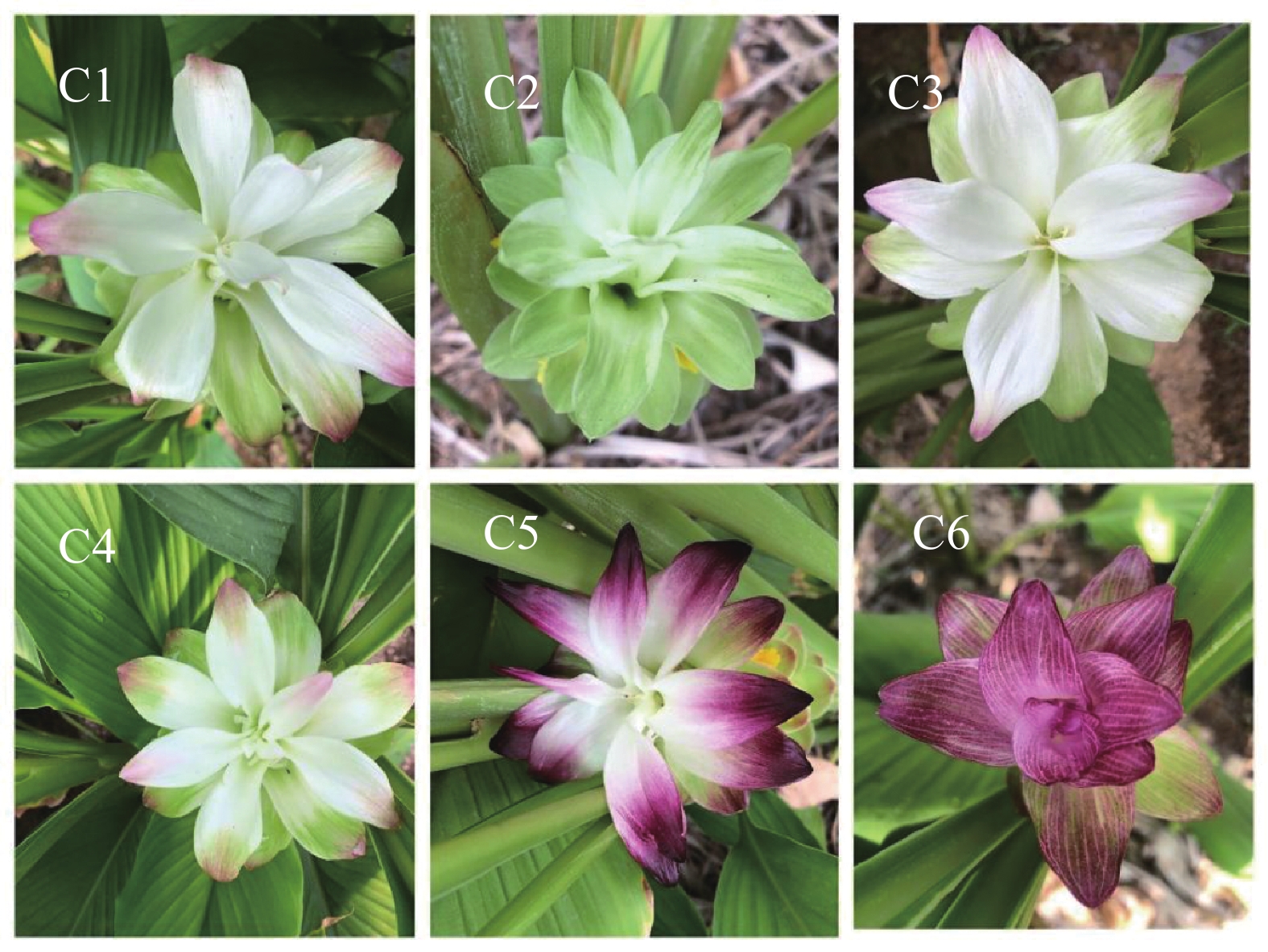
1250 ~1800 mm,日照充足,土壤为pH6.8~7.3的中性至微酸性的砂壤土,适宜姜黄生长。所有种质均已在该基地成功引种并规范化栽培超过2年,生长状况一致。样品于2024年10月上旬集中采集,此时正值盛花期,花序苞片已充分舒展、色泽鲜亮,大部分小花处于半开放至全开放状态。样品具体信息详见表1和图1。样品种质
Sample germplasm来源
Origin of the cultivar主要性状差异 Main trait differences 株高/cm
Plant height顶苞颜色
Apical bract color根茎剖面颜色
Rhizome cross-
section color根茎长/cm
Rhizome lengthC1 福建泉州市德化县雷锋镇潘祠村 175~190 白粉色 浅黄色 10.0~13.5 C2 福建泉州市洛江区马甲镇梧峰村 155~175 绿色 橙黄色 8.0~10.0 C3 福建漳州市平和县崎岭乡顶寨村 160~180 白粉色 浅黄色 8.5~10.0 C4 四川乐山市犍为县罗城镇黎明村 115~130 白粉色 亮黄色 5.5~7.5 C5 广西防城港东兴市东兴镇大田村 130~155 白紫色 浅黄色 7.5~9.7 C6 四川宜宾市兴文县莲花镇长岭村 120~145 紫红色 橙黄色 5.0~6.7 Table 1. The information of Curcuma longa samples
Figure 1. Inflorescences of Curcuma longa samples
-
主要仪器:静态顶空−气相色谱−质谱联用仪(7697A−7890B−
5977 ,美国安捷伦公司);HP−5ms色谱柱(30 m × 0.25 mm × 0.25 μm,美国安捷伦公司);电子天平(CP2202C,上海奥豪斯仪器有限公司);多功能植物萃取物(精油)生产机组(SJ−HX001,福建世纪海峡农业发展投资有限公司)。GC-MS参数为静态顶空(SHS)条件:取试验材料花序的苞片10.0 g放入20 mL顶空钳口瓶中,密封瓶口;加热箱温度50 ℃,定温环温度50 ℃,传输线温度70 ℃,平衡时间15 min,进样持续时间0.50 min。气相色谱质谱(GC-MS)条件:进样口温度为230 ℃;载气为高纯氦气(99.999%),恒定流量0.8 mL·min−1;分流比5:1;溶剂延迟时间0.5 min。升温程序:从初始温度为45 ℃,保持3 min,以25 ℃·min−1升至250℃,总时长11.2 min;四级杆温度150 ℃,离子源为EI,离子源温度250 ℃,电子能量70 eV,扫描范围50~600 m·z−1;采集方式为SCAN扫描。
-
采用ROAV评价花序各挥发性成分对总体香气的贡献,参考文献[13,15]的方法,定义对花香气贡献最大成分的ROAVstan=100,其他挥发性成分的ROAV,按下式计算:
式中:Ci为挥发性成分的相对含量(%);Ti为挥发性成分的气味阈值(μg·kg−1);Cstan为对姜黄的花香气贡献最大组分的相对含量(%);Tstan为对姜黄的花香气贡献最大组分的气味阈值(μg·kg−1)。
-
挥发性成分经过SHS-GC-MS分离,质谱数据系统检索及NIST 2014标准质谱图数据库比对,采用峰面积归一化法进行定量分析,计算各成分的相对含量[16]。利用Microsoft Excel 2010进行数据处理。
-
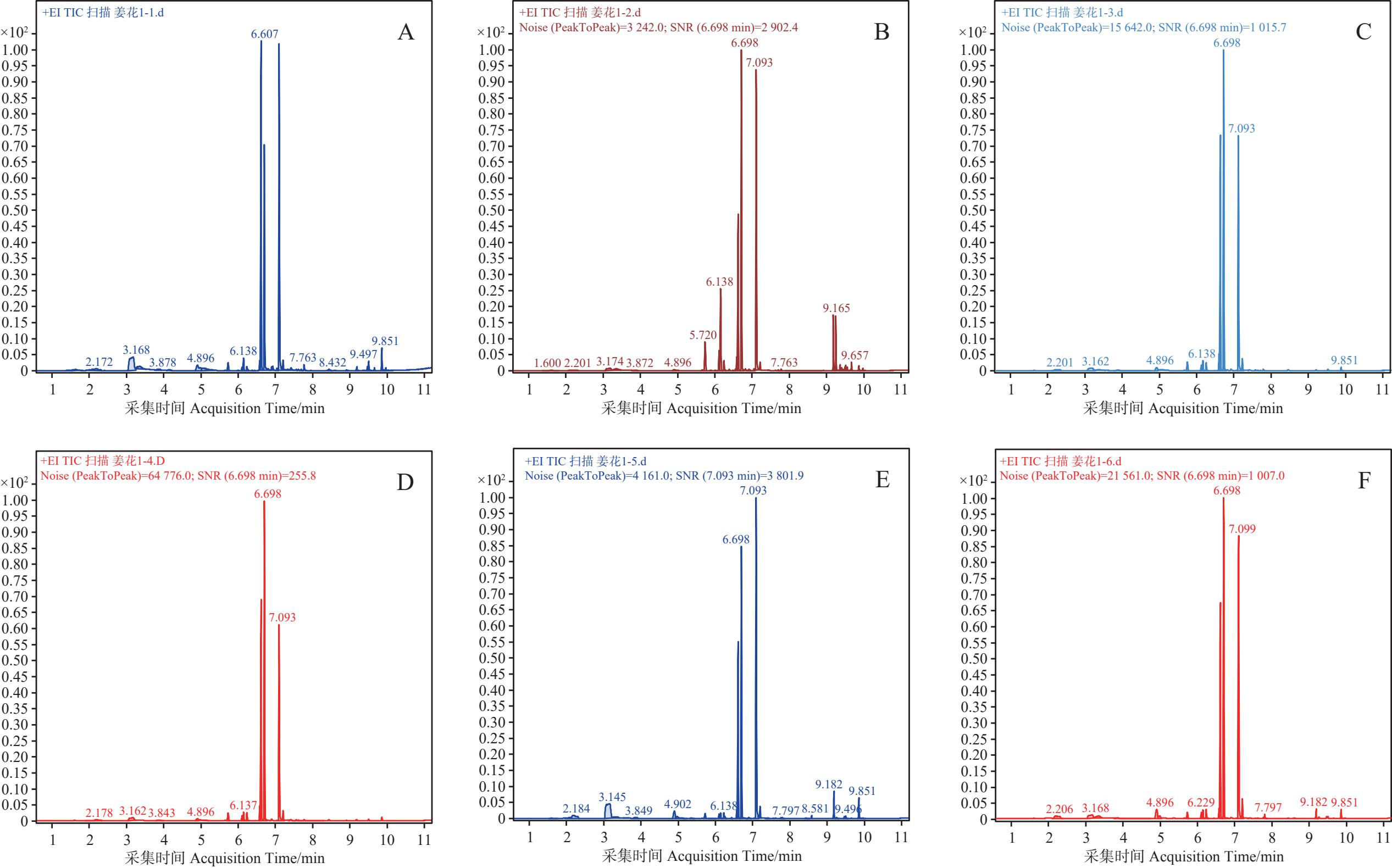
采用SHS-SGC-MS技术对6个姜黄种质花序的挥发性成分进行分析,获得总离子流图(total ion chromatogram,TIC;图2)。经筛选剔除匹配度低于<80%、结构不明确及色谱柱流失所引起的峰,最终鉴定出53个挥发性成分(表1)。各样品挥发性成分总相对含量在98.78%~99.87%,表明分析结果具有良好的代表性。主要挥发性成分包括3−蒈烯(18.53%~37.44%)、桉叶油醇(14.85%~28.66%)、甲酸芳樟酯(23.39%~32.30%)、2−甲基丁腈(1.45%~10.98%)、β−月桂烯(0.47%~10.27%)和4−己烯−1−醇(0.07%~2.26%)等。
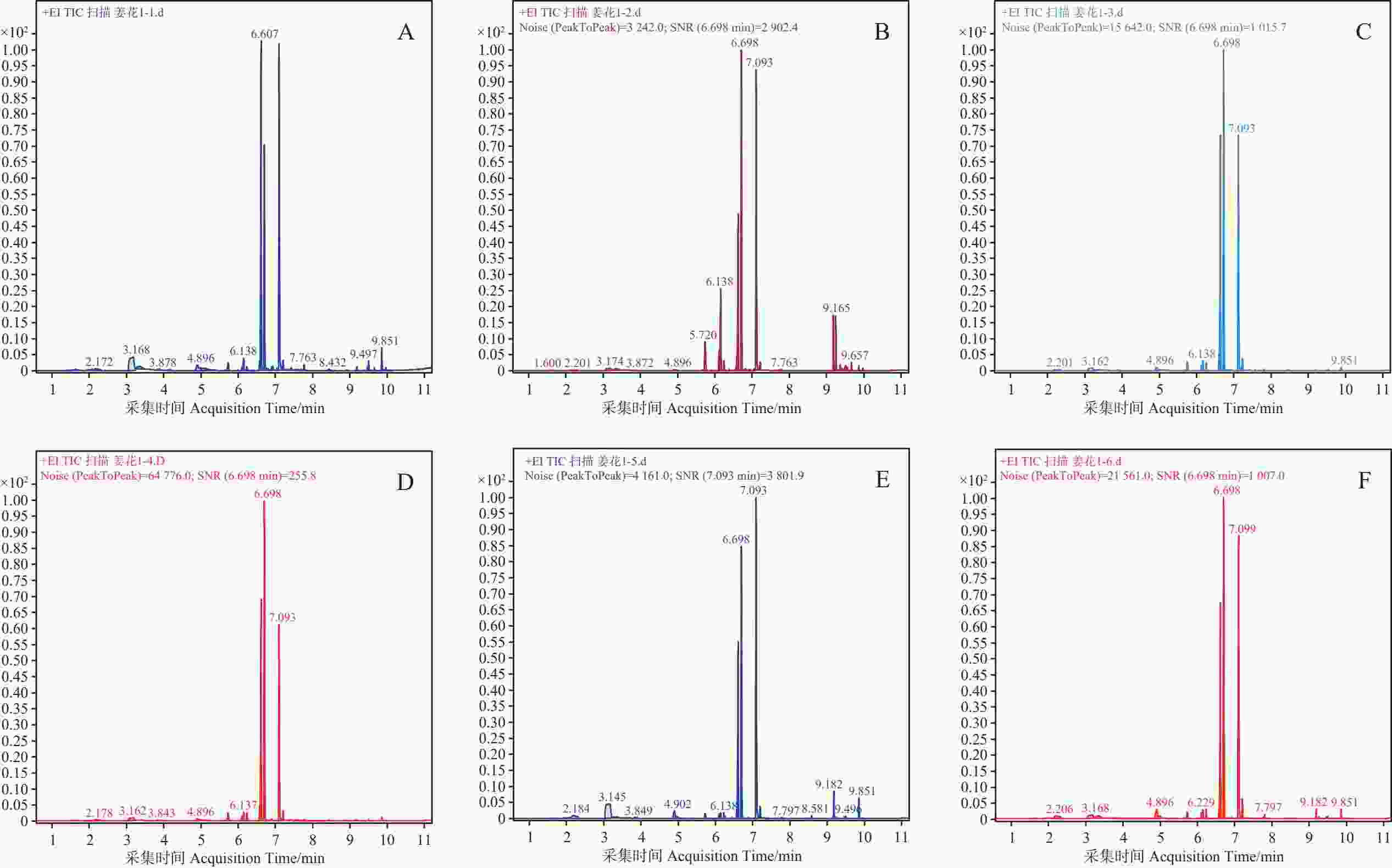
Figure 2. TIC of volatile compounds in inflorescences of different Curcuma longa germplasms
由表2与图2可知,姜黄花序挥发性成分以萜烯类、醇类和酯类为主,其相对含量与组成在不同种质间存在显著差异。萜烯类化合物数量最多(19种),相对含量介于24.23%~54.91%;酯类12种,含量范围为24.03%~35.51%;醇类8种,含量为15.27%~32.76%。此外,还鉴定出烃类7种(1.01%~3.73%)、醚类2种(0.24%~2.06%)及其他类别5种(1.51%~11.20%)。萜烯类成分在所有品种中均占比较高,尤其在C2中达到54.91%,其中3−蒈烯(30.17%)、β−月桂烯(10.27%)和丁香烯(3.85%)含量突出。醇类中桉叶油醇普遍存在于各品种中,在C1中含量最高(28.66%)。酯类中甲酸芳樟酯分布较为均匀且含量显著(23.39%~32.30%);C5中酯类总量最高(35.51%),其中苯甲酸异戊酯含量达2.22%。烃类、醚类及其他类成分虽然占比较低,但部分品种中特定成分含量突出,如C5中2−甲基丁腈含量为10.98%,可能对整体香气风格产生重要影响。
类别
Class编号
Code化合物
Compound化学文摘服务号
CAS No.相对含量 Relative Content/% C1 C2 C3 C4 C5 C6 萜烯类
Terpenes1 α−水芹烯 α-Phellandrene 99-83-2 − 0.28 0.10 0.10 − 0.05 2 莰烯 Camphene 79-92-5 − 0.10 − − − − 3 β−水芹烯 β-Phellandrene 555-10-2 0.37 2.22 0.71 0.73 0.53 0.66 4 γ−柠檬烯 γ-Limonene 499-97-8 1.28 − 1.45 1.33 1.51 2.15 5 β−月桂烯 β-Myrcene 123-35-3 0.47 10.27 1.02 1.11 − − 6 β−松油烯 β-Terpinene 99-85-4 − 0.18 − − − − 7 D−柠檬烯 D-Limonene 5989 -27-50.80 1.13 1.72 0.81 0.09 8 3−蒈烯 3-Carene 13466 -78-918.53 30.17 34.43 37.44 23.85 32.49 9 水合桧烯 trans-Sabinene hydrate 17699 -16-00.08 0.07 − − − − 10 丁香烯 Caryophyllene 87-44-5 − 3.85 − − − − 11 反式−β−金合欢烯 (E)-β-Famesene 18794 -84-8− 3.50 − − − − 12 律草烯 Humulene 6753 -98-6− 0.46 − − − − 13 (+)−香橙烯 Aromandendrene 489-39-4 − 0.23 − − − − 14 β−柏木萜烯 (+)-β-Funebrene 79120 -98-2− 0.15 − − − − 15 β−依兰油烯 β-Muurolene 30021 -74-0− 1.24 − − − − 16 金合欢烯 α-Farnesene 502-61-4 0.69 − 0.50 0.17 0.26 0.16 17 δ−杜松烯 δ-Cadinene 483-76-1 0.22 0.68 − − − − 18 角鲨烯 Squalene 111-02-4 1.60 0.38 − 0.36 1.51 0.65 19 1−表双环倍半水芹烯
(+)-epi-Bicyclosesquiphellandrene54274 -73-60.19 − − − 0.05 − 小计 24.23 54.91 39.93 41.24 28.52 36.25 醇类
Alcohols1 2,2,4,4−四甲基−1,3−环丁二醇
2,2,4,4-tetramethyl-1,3-Cyclobutanedil3010 -96-6− − − − − 0.26 2 4−己烯−1−醇 (E)-4-Hexen-1-ol 928-92-7 2.19 0.07 1.57 0.72 1.81 2.26 3 桉叶油醇 Eucalyptol 470-82-6 28.66 14.85 27.17 28.03 17.45 20.87 4 紫苏醇 Perillyl alcohol 536-59-4 0.44 − − − − 0.06 5 苯乙醇 Phenylethyl Alcohol 60-12-8 0.45 − − − − − 6 3−苯丙醇 3-Phenylpropanol 122-97-4 0.45 0.04 0.13 0.13 0.07 0.08 7 罗勒烯醇 Ocimenol 5986 -38-90.09 − − − − − 8 α−松油醇 α-Terpineol 98-55-5 0.48 0.31 0.16 0.14 − − 小计 32.76 15.27 29.03 29.02 19.33 23.53 酯类
Esters1 异戊酸甲酯 Methyl isovalerate 556-24-1 0.47 0.09 0.11 0.39 0.39 − 2 1,6−己二醇二丙烯酸酯
Hexamethylene diacrylate13048 -33-4− − − − − 0.67 3 丙烯酸丁酯
2-Propenoic acid, butyl ester141-32-2 1.94 − − − 0.19 0.23 4 丁酸异戊酯 Isoamyl N-butyrate 106-27-4 0.06 − − − 0.09 − 5 2−(5−甲基−5−乙烯基四氢呋喃−2−基)
丙烷−2−基碳酸乙酯
Ethyl 2-(5-methyl-5-vinyltetrahydrofuran-
2-yl)propan-2-yl carbonate1000373 -80-30.16 − − − − − 6 甲酸芳樟酯 Linalyl formate 115-99-1 25.71 25.95 25.68 23.39 32.30 30.43 7 乙酸苄酯 Benzyl acetate 140-11-4 0.07 − 0.10 0.08 − − 8 水杨酸甲酯 Methyl salicylate 119-36-8 − − − − 0.10 0.39 9 苯甲酸异丁酯 Isobutyl benzoate 120-50-3 − − − − 0.22 0.06 10 2−甲基丁酸苯甲酯
benzyl 2-methyl butyrate56423 -40-60.05 − − − − − 11 戊酸苄酯 benzyl valerate 10361 -39-40.05 − − − − − 12 苯甲酸异戊酯 Isoamyl Benzoate 94-46-2 0.39 0.14 0.17 2.22 0.81 小计 28.90 26.04 26.03 24.03 35.51 32.59 烃类
Hydrocarbons1 氟环己烷 Fluorocyclohexane 372-46-3 1.39 − − − − − 2 1−甲基环戊烯 Methylcyclopentene 693-89-0 − − 0.89 1.07 2.66 1.85 3 3−(2−丁烯−1−基氧基)−1−丁烯
3-(2-butenyloxy)-1-Butene1476 -05-7− 0.30 − − − − 4 4−乙基−3−乙烯环己烷
4-Ethyl-3-ethylidenecyclohexene61233 -77-00.24 − − − − − 5 反式−4,8−二甲1,3,7−三烯
(E)-4,8-Dimethylnona-1,3,7-triene19945 -61-00.86 0.59 1.23 1.07 1.07 1.64 6 3−氨基苯乙炔
3-Aminophenylacetylene54060 -30-9− − − 0.21 − − 7 邻伞花烃 o-Cymene 527-84-4 − 0.12 − − − − 小计 2.49 1.01 2.12 2.35 3.73 3.49 醚类
Ethers1 庚醚 1-heptoxyheptane 629-64-1 1.74 0.67 0.49 0.32 0.74 0.09 2 异丁香酚甲醚 (E)-methyl isoeugenol 93-16-3 0.32 − − − 0.19 0.15 小计 2.06 0.67 0.49 0.32 0.93 0.24 其他
Others1 2−甲基丁腈 2-methylbutylnitrile 18936 -17-98.41 1.45 2.06 2.44 10.98 2.34 2 异丁香酚 Isoeugenol 97-54-1 − − − − 0.14 0.15 3 吲哚 Indole 120-72-9 0.27 − 0.21 − 0.08 0.08 4 安息香醛 Benzaldehyde 100-52-7 0.06 0.06 − − − − 5 甜瓜醛 Melonal 106-72-9 − − − 0.41 − 0.11 小计 8.74 1.51 2.27 2.85 11.20 2.68 合计 53 99.18 99.41 99.87 99.81 99.22 98.78 注:“−”表示未查询或检测出。下同。 Note: "−"indicates not detected or not queried.similarly hereinafter. Table 2. Analysis results of volatile components in inflorescences of different C. longa germplasms by SHS-GC-MS
-
结合文献资料[17−25],获取了31种香气化合物的气味阈值,并依据1.3中所述公式计算其相对气味活度值(ROAV),结果列于表3。姜黄花序挥发性香气成分组成丰富,主要包括萜烯类、醇类、酯类、烃类、醚类以及其他化合物,这些成分共同构成了其独特而复杂的香气特征。萜烯类成分中,β−月桂烯、丁香烯及D−柠檬烯3个成分贡献显著,赋予样品黑胡椒、薄荷、松木与柑橘等多样香气属性[23, 26]。醇类中桉叶油醇,呈现出明显的桉叶与樟脑香气[27];苯乙醇则带有玫瑰和面包香韵[28]。酯类成分如异戊酸甲酯、丙烯酸丁酯和丁酸异戊酯,提供整体香气中的果香调,表现出苹果、桃、菠萝和香蕉等风味特征[29−30]。此外,其他类化合物中的甜瓜醛贡献了清晰的瓜香和脂蜡香[31],而异丁香酚则提供典型的丁香香气[32]。总体而言,姜黄花序香气层次丰富,以果香、木香、薄荷香和花香为主调,多种化合物共同作用,形成强烈而持久的芳香特征。
编号
Code类别
Class化合物
Compound气味阈值/(μg·kg−1)
Olfactory threshold相对气味活度值 ROAV 香气描述
Aroma descriptionC1 C2 C3 C4 C5 C6 1 萜烯类
Terpenesα−水芹烯 0.04 − 1.02 0.47 0.06 − 0.11 黑胡椒和薄荷香气 2 莰烯 0.88 − 0.02 − − − − 木香、薄荷味 3 β−水芹烯 0.036 1.54 9.01 3.69 0.49 2.45 1.67 * 4 γ−柠檬烯 0.21 0.91 − 1.29 0.15 1.20 0.93 柑橘味、清淡的香脂香 5 β−月桂烯 0.015 0.56 100.00 12.71 1.80 − − 清淡的香脂香气 6 γ−松油烯 0.26 − 0.10 − − − − * 7 D−柠檬烯 0.034 3.52 4.85 9.46 - 3.97 0.24 柑橘味 8 3−蒈烯 9.30 0.30 0.47 0.69 0.10 0.43 0.32 松木样香气 9 水合桧烯 0.098 0.12 0.10 − − − − * 10 丁香烯 0.016 − 35.14 − − − − 丁香、松木香、柑橘香 11 律草烯 0.16 − 0.42 − − − − 酒花香、丁香 12 β−柏木萜烯 0.005014 − 4.37 − − − − * 13 金合欢烯 0.087 1.19 − 1.07 0.05 0.50 0.17 苹果香、玫瑰香 14 醇类
Alcohols4−己烯−1−醇 0.110 2.98 0.09 2.67 0.16 2.74 1.87 * 15 桉叶油醇 0.0508 84.34 42.70 100.00 13.46 57.25 37.35 桉叶香气、樟脑香 16 紫苏醇 7.00 3.00 − − − − − 琥珀香、 17 苯乙醇 0.012 5.61 − − − − − 玫瑰味、面包香 18 3−苯丙醇 0.42 0.16 0.01 0.06 0.01 0.03 0.02 甜花香、甜蜜饯香 19 α−松油醇 0.86 0.08 0.05 0.03 − − − 油脂香气、薄荷香 20 酯类
Esters异戊酸甲酯 0.0044 15.97 2.99 4.67 2.16 14.77 − 果香(苹果、菠萝、香蕉) 21 丙烯酸丁酯 0.0029 100.00 − − − 10.92 7.21 果香、香蕉味 22 丁酸异戊酯 0.00015 59.79 − − − 100.00 − 果香 23 乙酸苄酯 0.364 0.03 − 0.05 0.01 − − 茉莉花香、果香 24 水杨酸甲酯 0.016 − − − − 1.04 2.22 薄荷香 25 苯甲酸异戊酯 0.25 0.23 − 0.10 0.02 1.48 0.29 果香、龙涎香 26 烃类 Hydrocarbons 邻伞花烃 0.004 − 4.38 − − − − 清香味 27 醚类
Ethers异丁香酚甲醚 1.60 0.03 − − − 0.02 0.01 花香(康乃馨、石竹) 28 其他
Others异丁香酚 0.01 − − − − 2.33 1.36 丁香味 29 吲哚 0.0081 4.98 − 4.85 − 1.65 0.90 花香 30 安息香醛 0.085 0.11 0.10 − − − − 苦杏仁、樱桃及坚果香 31 甜瓜醛 0.0001 − − − 100.00 − 100.00 瓜香、清香、脂蜡香 注:“*”表示无相关香气描述。 Note:"*"indicates no relevant aroma description. Table 3. ROAV analysis of volatile compounds inflorescences of different C. longa germplasms
不同种质间的特征香气成分存在显著差异,主要体现在关键香气成分的种类及其ROAV贡献强度上。C2(泉州洛江)的整体香气表现最为突出,其主要特征成分包括β−月桂烯(ROAV 100)、丁香烯(ROAV 35.14)和桉叶油醇(ROAV 42.70),共同赋予该种质浓郁的果香、松木香和桉叶香气。C1(泉州德化)与C5(广西防城港)则以酯类成分为主,如C1中丙烯酸丁酯(ROAV 100)及C5中丁酸异戊酯(ROAV 100),表现出浓郁的水果香气风格[33]。C3(漳州)的香气组成中醇类与萜烯相对均衡,其中桉叶油醇(ROAV 100)、β−月桂烯(ROAV 12.71)与D−柠檬烯(ROAV 9.46)共同奠定了柑橘香与樟脑香的基底。C4(四川乐山)和C6(四川宜宾)中甜瓜醛(ROAV 100)贡献显著,表现出清晰的瓜香和脂蜡香特征。整体上,不同种质间香气差异主要源于萜烯类和酯类成分的组成及含量变化,形成了从果香主导到木香、清香等不同风格的整体香韵。
-
本研究采用SHS-GC-MS技术对6个姜黄种质的花序的挥发性成分进行了分析,共鉴定出53种化合物,总相对含量均高于98.78%,表明这些挥发性成分构成了姜黄香气形成的物质基础。从组成类别来看,萜烯类、醇类和酯类是姜黄花序中最主要的三类挥发性成分,其中萜烯类不仅在种类数量(19种)上占优势,在相对含量(最高达54.91%)上也居于主导,这与姜黄作为姜科植物富含萜类次生代谢产物的特性相吻合[34]。不同种质间挥发性成分的含量分布存在明显差异,尤其值得注意的是,同一省份的不同种质也表现出显著化学多样性。例如,同产于福建省的C2(泉州洛江区)中萜烯类总含量最高,其中,3−蒈烯、β−月桂烯和丁香烯的含量显著高于其他品种,提示该品种可能具有更强烈的木质和胡椒香韵;而同样来自福建的C1(泉州德化)和C3(漳州)则分别以酯类和均衡的萜烯-醇类组合为特征。相比之下,C5(广西东兴)中酯类总量最高(35.51%),尤其是以苯甲酸异戊酯的积累增强其果香调。而两个四川产区的C4(乐山)与C6(宜宾)均显示出甜瓜醛的显著贡献,体现出地理邻近产区在香气特征上可能的相似性。这些成分差异不仅体现了品种间的遗传多样性,也可能受栽培地域、生长条件等因素影响[35−36],为今后开展姜黄花香气品质定向育种的研究提供了理论依据。
通过ROAV分析,本研究进一步识别出对姜黄花序整体香气具有关键贡献的化合物。ROAV值高的成分通常香气阈值较低,即便在微量存在时仍对香气感知起决定性作用[26]。在萜烯类中,β−月桂烯、丁香烯及D−柠檬烯表现出较高的香气活性,共同赋予样品以黑胡椒、松木和柑橘类香气。醇类中的桉叶油醇在所有种质中均具有极高ROAV值,其典型的樟脑和桉叶清香成为姜黄花的基础香调。酯类成分,如异戊酸甲酯、丙烯酸丁酯和丁酸异戊酯,显著增强了整体香气中的果香特征,如苹果、桃、香蕉和菠萝风味。此外,甜瓜醛和异丁香酚等其他类化合物也在特定种质中贡献了瓜香和丁香韵。由此可见,姜黄花序的香气并非由单一组分决定,而是由萜烯类、醇类和酯类等多类化合物共同作用的结果,整体呈现以果香、木香、薄荷香和花香为主体的复杂香气轮廓。姜黄花序的挥发性成分与根茎、叶的挥发性成分存在较大差别,根茎挥发油主要成分有芳姜黄酮、姜黄酮、姜烯、β−红没药烯和倍半水芹烯等[37−39],叶挥发油主要成分为榄香烯、蛇麻烯、莪术醇和莪术二酮等[40−41]。
不同姜黄种质的花序在香气属性上表现出明显区别,其差异主要源于关键香气成分的种类、含量及ROVA值的综合影响。从地理分布看,福建产区的种质整体香气表现更为多样:C2(泉州洛江区)香气最为突出,主要由β−月桂烯、丁香烯和桉叶油醇共同作用,呈现出强烈的果香、松木香和桉脑香特征。C1(泉州德化)则因酯类物质含量较高而呈现出更浓郁的水果香调,其中丙烯酸丁酯和丁酸异戊酯等成分显示出极强的香气贡献能力。C3(漳州)的香气则相对均衡,萜烯与醇类物质配比较为协调,柑橘与樟脑香成为其基底风味。四川产区的2个种质(乐山与宜宾)均表现出瓜香和脂蜡香,形成区别于其他产区的香气风格。而广西产区(C5)则以酯类总量最高为特征,在果香表现上尤为突出。这些差异不仅体现了种质间挥发性成分积累的代谢差异,也可能与其基因表达、酶活性及环境适应策略有关[42-43]。
综上,本研究通过SHS-GC-MS技术结合ROAV分析,分析比较了6个姜黄种质花序的挥发性成分及香气贡献。结果表明,姜黄的花香气物质以萜烯类、醇类和酯类为主,不同种质间香气特征的差异既反映地理来源影响(如四川产区的瓜香特征),也体现同一区域内不同种质的代谢多样性(如福建产区的化学型分化)。该研究不仅明确了各种质的香气构成及种间联系,也为姜黄香气品质的品种选育与区域化开发提供了理论依据。后续工作可进一步整合多组学与分子生物学手段,深入解析香气成分合成的调控机制与地理适应规律,推动姜黄高香气品质种质的创新与利用。
Identification of key aroma compounds extracted from inflorescences of Curcuma longa by SHS-GC-MS and ROAV
DOI: 10.15886/j.cnki.rdswxb.20250125
- Received Date: 2025-09-17
- Accepted Date: 2025-12-18
- Rev Recd Date: 2025-12-07
- Publish Date: 2026-07-01
-
Key words:
- Curcuma longa /
- static headspace /
- inflorescences /
- aroma components /
- relative odor activity value
Abstract: Inflorescences of different accessions of Curcuma longa germplasm were collected to analyze their volatile composition and aroma contributions with a view to elucidating the effects of cultivar and geographical origin on their aroma profiles. Static headspace-gas chromatography-mass spectrometry (SHS-GC-MS) was employed to analyze the volatile compounds from six accessions o C. longa germplasm. Key aroma-active substances were assessed by the relative odor activity value (ROAV). The results showed that 53 volatile compounds were identified, with total relative contents all exceeding 98.78%. Terpenes, alcohols, and esters were the predominant classes, among which terpenes showed the highest relative content (up to 54.91%). Significant compositional differences were observed among the germplasm accessions, and metabolic diversity was also noted within the same province: C2 (Luojiang, Quanzhou) exhibited prominent terpene content, imparting woody and peppery notes; C1 (Dehua, Quanzhou) and C3 (Zhangzhou) were characterized by a high ester content and a balanced terpene-alcohol profile, respectively; the Guangxi germplasm possessed the highest total ester content (35.51%), contributing a distinct fruity aroma; the key aroma component in the germplasm from Sichuan was melonal, indicating similar regional aroma characteristics. ROAV analysis indicated that β-myrcene, eucalyptol, and methyl isovalerate, among others, were key aroma compounds, collectively shaping a complex aroma profile dominated by fruity, woody, minty, and floral notes. The aroma profile of C. longa inflorescences is influenced by both germplasm and geographical origin. Terpenes (highest proportion: 54.91%), esters (e.g., 35.51% in the Guangxi germplasm), and key ROAV components (e.g., β-myrcene, eucalyptol) constitute the material basis of their aroma. These findings provide, for the first time, clear evidence of the region-specific aroma profiles in C. longa inflorescences (e.g., the contribution of melonal in Sichuan germplasm and the metabolic diversity in Fujian germplasm), offering a scientific basis for selecting high-aroma-quality germplasm and developing regional cultivation strategies for C. longa.
| Citation: | Chen Pinpin, You Guichun, Liu Liang, Ma Xiaojuan, Chen Rizhong. Identification of key aroma compounds extracted from inflorescences of Curcuma longa by SHS-GC-MS and ROAV[J]. Journal of Tropical Biology, 2026, 17(4): 716-725. doi: 10.15886/j.cnki.rdswxb.20250125

|
 DownLoad: